.svg)


.svg)
.svg)

.svg)
.svg)

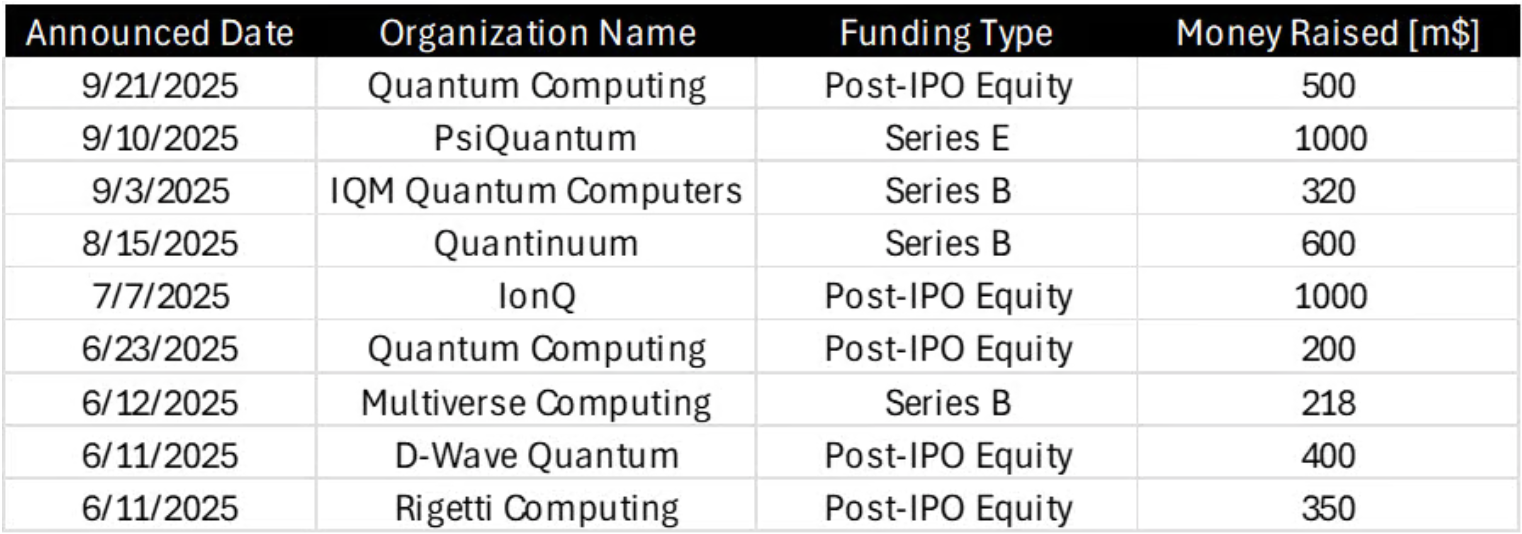
Since summer, quantum is back in fashion. Retail chatter and sharp moves in IonQ, Rigetti, and D-Wave signal an inflection. Capital has followed: IonQ priced a $1 billion raise; Rigetti and D-Wave completed $350 million and $400 million ATMs. Excitement is real. Proof is thinner.
A qubit’s appeal is combinatorics. A classical bit is a coin lying flat—heads or tails. A qubit is a coin spinning in the air—both states at once until measured. Two qubits encode four possibilities at once; three, eight; fifty, more than a quadrillion. That parallelism is why quantum could search vast spaces faster than classical computers. It is also why errors kill value so quickly.
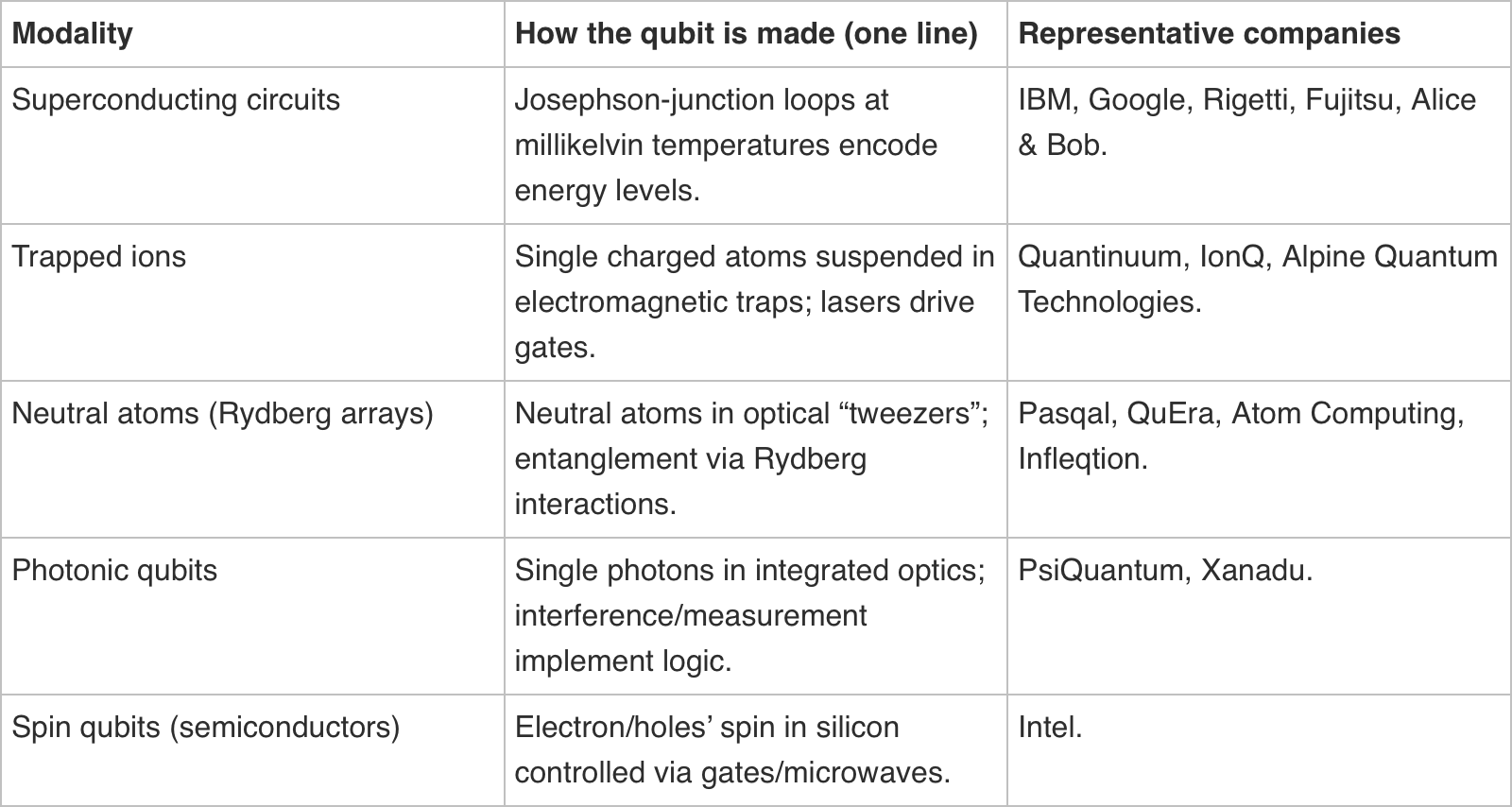
Not all qubits are built alike—just as “bits” once lived in vacuum tubes before the transistor won. Today’s contenders: superconducting circuits (IBM, Google), trapped ions (Quantinuum, IonQ), neutral atoms (Pasqal, QuEra), photonic qubits (PsiQuantum, Xanadu), and spin qubits (Intel). Each trades speed, stability, and scalability differently. No architecture has “won” yet.
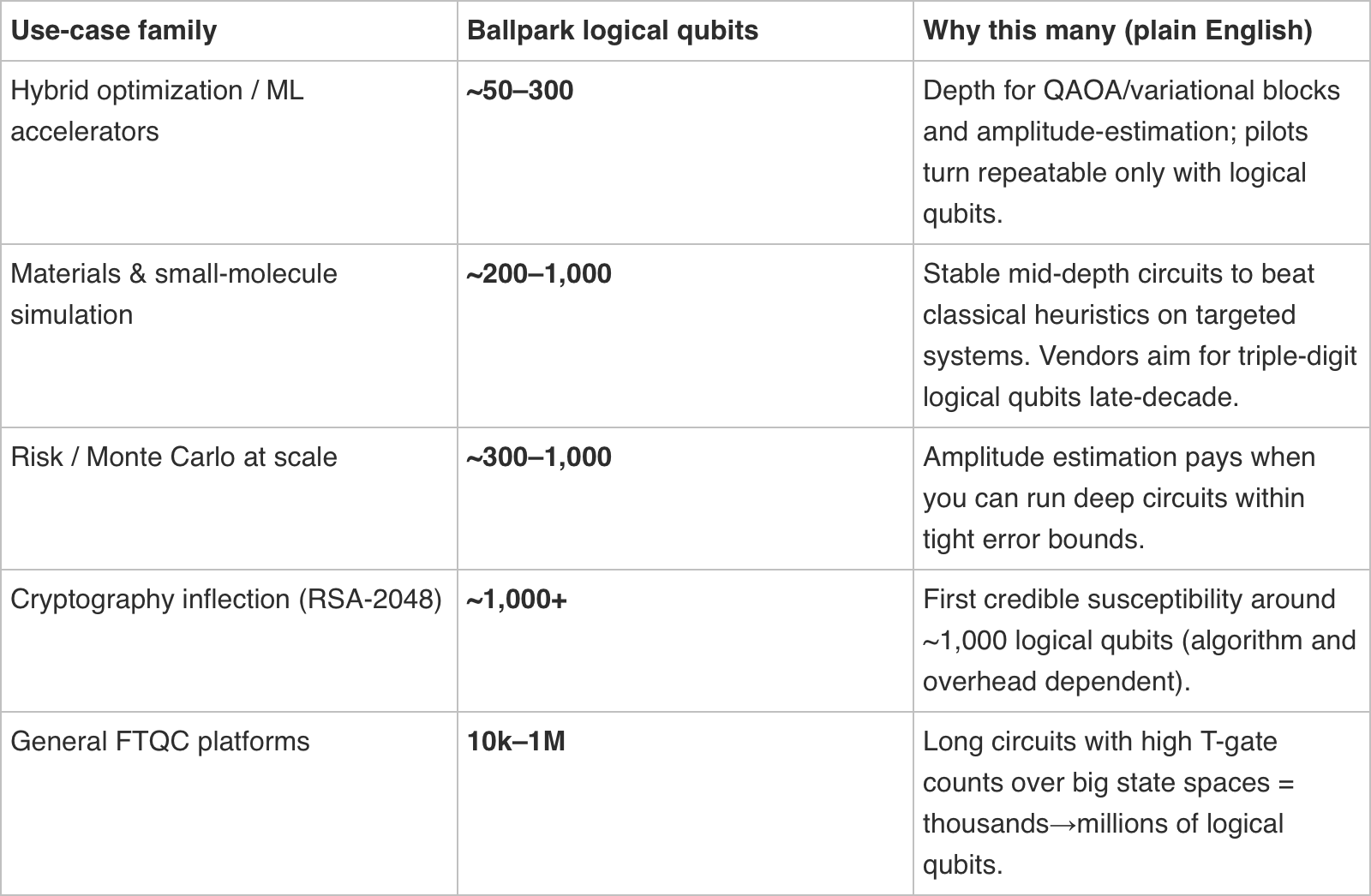
Physics is cruel. Qubits decohere with noise, heat, and time. Fault tolerance solves this by stitching many imperfect, physical qubits into one reliable logical qubit. Logical qubits give enterprises what they buy: repeatability, auditability, and unit economics, plus a stable software target. Watch three milestones: (1) logical-qubit counts rising from single digits to hundreds; (2) falling physical-to-logical overhead; (3) credible roadmaps to fault-tolerant subsystems.
Money, for now, is concentrated in the public sector.Quantum-computing revenue totaled $650–750 million in 2024, expected to surpass $1 billion in 2025. McKinsey pegs the 2024 “market size” (revenues + investments + internal big-tech funding) at ~$4 billion, rising to $16–37 billion by 2030. Pasqal’s neutral-atom systems illustrate the near-term path: integrate quantum as an accelerator inside classical/HPC workflows. Deployments span EU and Middle Eastern supercomputing centers; pilots include Crédit Agricole (credit-risk modeling) and EDF (EV-charging optimization).
The domain is inflecting and drawing in retail. Prices and placements prove it. But the bridge from physics to profit runs through logical qubits, scarce capacity, and credible roadmaps. Treat 100–300 logical qubits as the first ROI band—and ~1,000 logical as the policy and market watershed. For investors, the question is simple but brutal: are you buying the future of computing—or subsidizing physics research?

.svg)
.svg)
.svg)
.svg)
.svg)
.svg)